


The Art of Postpartum Restoration: A Deep Dive into Mastopexy AugmentationRestoring Firmness for Mothers After ChildbirthBy: Dr. Aphirak Wongsaosup (Dr. Teng) – Specialist Plastic Surgeon


Prologue: Traces of Love and Echoes from the Mirror
Hello everyone, I am Dr. Teng (Dr. Aphirak).
In my consultation room at Aurora Clinic, many stories are told through tears. But the stories that always resonate most deeply with me as a physician are those of "postpartum mothers."
"Doctor, since my baby stopped breastfeeding, I haven't dared to look at myself in the mirror while showering." "I used to be stylish and confident, but now my breasts are flat and sagging like socks filled with water. I feel like I've lost my womanhood."
These sentences aren't just about superficial vanity; they are about Identity and Self-esteem. Society often tells women to sacrifice and be proud of the marks of motherhood—which is truly noble. However, we should not deny the truth that every woman desires to feel beautiful and sexy in her own body.
The change in your breast shape is not your fault. It’s not because you didn't exercise, and it doesn't mean you didn't take care of yourself. It is an unavoidable "biological rule."
I wrote this article to provide accurate medical knowledge, debunk myths, and present the scientific solution known as "Mastopexy Augmentation" (Breast Lift with Implants). This is not just surgery; it is the art of reconstructing shattered confidence.
If you are facing this condition, know that you are not alone. And most importantly... it can be fixed.
Chapter 1: The Anatomy of Motherhood – Why Do Breasts Sag and Flatten?

To solve a problem, we must first understand its foundation. A woman's breast does not contain muscle; it is a structure composed of Glandular Tissue (milk glands) and Adipose Tissue (fat), encased in skin and anchored to the chest wall by thin ligaments called Cooper's Ligaments.
What happens inside during pregnancy and breastfeeding?
The Expansion Phase: Hormones like estrogen, progesterone, and prolactin signal the milk ducts and glands to expand massively. Your breasts may grow by 2-3 cup sizes. This is when the skin and Cooper's Ligaments are stretched to their absolute limit—like a rubber band held taut for months.
The Involution Phase: Once the baby is weaned, hormone levels return to normal. The body undergoes "Breast Involution," where the milk glands shrink. The once-firm tissue contracts rapidly.
The Aftermath (Permanent Damage): The real issue is that the stretched skin and ligaments lose their elasticity. They cannot "snap back" to their original shape. What remains is a loose "skin envelope" over atrophied breast tissue. This leads to Upper Pole Emptiness (loss of fullness at the top) and Breast Ptosis (sagging due to gravity).
The Hard Truth: No cream, massage, or exercise in the world can shrink stretched skin or "re-inflate" atrophied glands. Postpartum Breast Surgery is the only medical solution that addresses the structural reality.
Chapter 2: The Scale of Sagging (The Regnault Classification)

When you visit me for a Breast Augmentation in Surat Thani or a Breast Lift in Samui, the first step is measuring your "level of sagging." In medicine, we use the Regnault Ptosis Scale, focusing on two reference points: the Inframammary Fold (IMF) (the crease under the breast) and the Nipple-Areola Complex.
Grade 1 (Mild Ptosis): The nipple is at the same level as the IMF crease.
Grade 2 (Moderate Ptosis): The nipple has fallen below the IMF crease but remains above the lower contour of the breast tissue.
Grade 3 (Severe Ptosis): The nipple is significantly below the IMF crease and points toward the floor. All breast tissue hangs downward.
Pseudoptosis: The nipple is above the IMF, but the lower breast tissue is deflated and hangs down (often caused by severe glandular atrophy).
This assessment is the key to your surgical plan—determining if you need a "Lift" or if "Implants" alone will suffice.
Chapter 3: The Disaster of "Oversizing" to Fix Sagging (The Snoopy Dog Deformity)

This is the most important chapter! More than half of my patients fear scarring and ask: "Doctor, can you just put in a huge implant to stretch the skin tight? I don't want a long scar."
I must answer honestly and firmly: "No."
If your breasts have Grade 2 or 3 ptosis, your skin is too loose to support weight. If a surgeon simply performs a Breast Augmentation with a large implant without a lift, the following happens:
The implant sits at the top (where the pocket was created), but your actual breast tissue and nipple—which are already sagging—will not "stick" to the implant. They will slide off and hang over the implant. This creates a double-contoured look known as Waterfall Deformity or Snoopy Dog Deformity (because from the side, it looks like the drooping nose of Snoopy).
Correcting this later is much harder and more painful than doing it right the first time. The correct solution for sagging is Mastopexy Augmentation (removing excess skin + lifting tissue + adding an implant).
Chapter 4: The Architecture of Scars (The Art of the Incision)

A Mastopexy is essentially "re-tailoring" a new garment for your breasts. Scars are inevitable, but with specialist techniques, I can hide and design them to be as discreet as possible.
Periareolar (Donut Lift):
Best for: Grade 1 Ptosis or those needing the nipple moved up 1-2 cm.
Technique: A ring of skin is removed around the areola, then "purse-string" sutures are used to tighten the skin around the implant.
Benefit: The scar blends into the edge of the areola, making it nearly invisible.
Vertical (Lollipop Lift):
Best for: Grade 2 Ptosis with moderate skin laxity.
Technique: An incision around the areola and a vertical line down to the IMF crease (shaped like a lollipop).
Benefit: This is the "Sweet Spot." It removes significant excess skin and prevents the breast from "bottoming out," creating a youthful, perky projection.
Anchor (T-Inverted Lift):
Best for: Grade 3 Ptosis, very large deflated breasts, or massive weight loss.
Technique: Incisions around the areola, vertically, and horizontally along the IMF (resembling an anchor).
Benefit: This is the ultimate tool for Breast Lift Surgery. It allows 360-degree control, removes all damaged skin, and allows the nipple to be perfectly repositioned. While the scar is longer, it is completely hidden within a bra.
Chapter 5: Choosing the Right Implant for a Lifted Breast

Once we manage the "Envelope" (skin), we address the missing "Volume" with Standard Silicone Implants. The golden rule here is: "Don't be greedy with size."
Postpartum skin is more fragile. If we use an implant that is too heavy, gravity will pull it down, causing Recurrent Ptosis (sagging again) sooner than expected. I recommend a size that fits your Base Width to create a natural "Upper Pole" fullness. Our trusted brands at Aurora Clinic include:
Motiva:

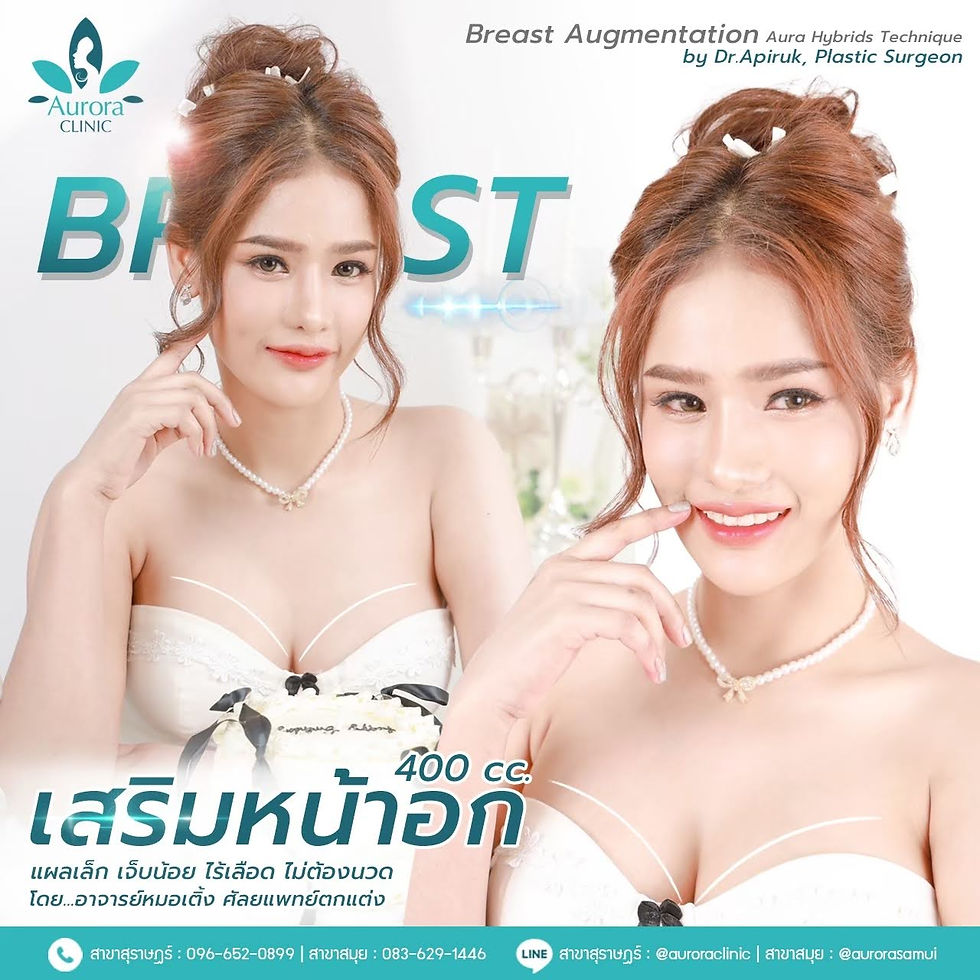
Breast augmentation transformation using Motiva Ergonomix 500cc with the Aura Hybrid technique, showcasing results in six days. Features Silk Surface (Nano Texture) to reduce friction and capsular contracture. The Ergonomix model is particularly soft, mimicking natural tissue by shifting from round to teardrop shape as you move.
Mentor: A world-class US FDA-approved brand. Its Cohesive Gel provides excellent projection and defined fullness.
The Dual Plane Mastery: For Mastopexy Augmentation, the Dual Plane technique is the gold standard. I place the top half of the implant under the muscle (Pectoralis Major) and the bottom half under the breast tissue. The muscle acts as an "internal hammock," supporting the weight and preventing pressure on the lower incision lines.
Chapter 6: Inside the Operating Room Protocol

A Mastopexy Augmentation is not a routine job; it is a high-level craft. At Aurora Clinic, we maintain hospital-grade safety:
The Art of Marking: Before you go under, I spend significant time with you standing up, using rulers and pens to mark incisions and nipple placement to the millimeter. Breast shape changes when you lie down, so standing marks are vital.
Specialist Anesthesiology: Surgery is performed under general anesthesia, monitored 1:1 by a specialist anesthesiologist throughout the procedure.
The Internal Bra (Parenchymal Reshaping): I don't just sew the skin. I anchor the internal breast tissue (Parenchyma) to the chest wall fascia, creating an "invisible internal bra" to prevent future sagging.
Tension-Free Closure: I use ultra-fine absorbable sutures in a Subcuticular (hidden) pattern. By shifting tension to the deeper tissue layers, I minimize the risk of wide scars or keloids.
Chapter 7: The Recovery Timeline

I'll be honest: recovering from a lift and implants requires more discipline than a simple augmentation.
Week 1 (The Soreness Phase): You will feel tightness and bruising. This is normal. Pain medication will manage the discomfort. You must wear a Support Bra 24/7, sleep elevated, and avoid lifting your arms.
Weeks 2-4 (The "Franken-boob" Phase): Your breasts might look high, swollen, and slightly "pointed." Don't panic! This is the result of surgical tension. Over time, the skin will relax, and the implants will "Drop and Fluff" into their natural position.
Months 3-6 (The Reality Phase): The shape settles. Swelling subsides into softness. Red scars begin to fade to light pink. You can return to normal exercise.
1 Year+ (The Final Result): Scars fade into thin white lines. Your breasts will be firm, youthful, and look so natural that no one would guess you’ve breastfed.
Chapter 8: Why Aurora Clinic Surat Thani & Samui?

Breast surgery, especially corrective cases, is a major life investment. Your body is not a place for someone to "practice."
If you live in Southern Thailand, traveling to Bangkok for major surgery involves risks—travel fatigue, vibrations from cars or planes affecting wounds, and difficulty with follow-up appointments.
Aurora Clinic provides hospital-grade standards right here:
Real Specialists: I (Dr. Aphirak) am a Board-Certified Plastic Surgeon specializing in breast aesthetics.
Surgical Standards: Our OR features Positive Pressure systems and sterile air filtration to minimize infection risks.
Close Follow-up: This is our biggest advantage. If you have any concerns or need a check-up, you can drive to see me immediately without booking a flight. We are with you from day one until your results are perfect.
Epilogue: Reclaiming Your Identity
Being a "Mother" is a beautiful role, but that sacrifice shouldn't mean losing your confidence forever.
A Mastopexy scar is a symbol of choosing to "Love and Care for Yourself." When you look in the mirror and feel happy, when you dress with confidence, that positive energy radiates to your children and your family.
My job is to use science and art to reconstruct the beauty you love. Allow yourself to be beautiful and sexy again.
Next Step: Let Dr. Teng Design Your New Silhouette
I am happy to provide a complimentary assessment of your sagging level. For an accurate evaluation, please send:
Photos: (Well-lit, no bra) Front view, 45-degree angle, and 90-degree side view.
History: Number of children and breastfeeding duration.
Stats: Current weight, height, and chest measurement.
Goals: Your expected size or desired outcome.
All information is kept strictly confidential. I, Dr. Aphirak, will personally review your case to design the best technique for your body.
Aurora Clinic - Samui Branch ✨
FACEBOOK: facebook.com/auroraclinicsamui
Add Line to book promotions: https://lin.ee/PJSVPOv6 (@aurorasamui)
TEL: 083-629-1446
Opening Hours: Open daily, 10:00 AM - 8:00 PM
Aurora Clinic - Surat Thani Branch ✨
FACEBOOK: facebook.com/auroraclinicsurat
TEL: 096-652-0899
Line: @auroraclinic
Opening Hours: Open daily, 10:00 AM - 8:00 PM
We warmly welcome everyone and are ready to care for you, ensuring you look beautiful and feel confident in your own unique way.


_250414_15.jpg)
_250414_28.jpg)
.png)
.png)


Comments