


Transforming Sagging into Firmness — Dr. Teng's Guide to Age-Appropriate Lifting Techniques


Hello, I'm Dr. Teng (Dr. Apirak Wongsawasup, License 35777), Plastic Surgeon and owner of Aurora Clinic Plastic Surgery Clinic.
If you're researching Facial Lifting (ยกกระชับหน้า), you've likely noticed subtle changes on your face—deepening lines, a softening jawline, or the loss of youthful plumpness.
As a Plastic Surgeon, I understand that true beauty is harmony and balance. Correcting laxity isn't just about "pulling"; it's about "restoring" the 3D facial structure at every level—from bone, fat, and muscle to the skin layer. These changes vary significantly across different age groups.
I've seen many patients waste time and money on ineffective procedures due to a lack of accurate facial structure diagnosis. Today, I'm setting out the "Age-Specific Lifting Guide" to help you understand your own aging mechanism and select the most appropriate and sustainable technique, whether it's Thread Lifts, Dermal Fillers, Autologous Fat Grafting (Baby Face Fat Grafting), or the use of Biostimulators like Olidia and Sculptra. At Aurora Clinic, in both our Surat Thani Aesthetic Clinic and Koh Samui Aesthetic Clinic, we are ready to safely guide you back to your best version.
I. The Foundation of Youth: The Mechanism of Facial Aging (The Multi-Layer Aging Process)
Successful Facial Lifting must start with a correct understanding of what happens to our faces over time. Aging isn't just about the "skin"; it's a change in structure across all layers, from the deepest to the outermost.
1.1. The Five Pillars of Facial Aging (5-Dimensional Structural Change)

Facial aging results from a complex process occurring simultaneously in five main layers, which is why a combined approach is necessary for correction.
1.1.1. Dimension 1: Bone Resorption and Skeletal Support

The Starting Point of Sagging: As we age, facial bones, especially around the eye sockets, temples, mid-cheeks, and chin, begin to resorb and recede.
Impact: Bone resorption removes the structural pillars supporting the overlying soft tissues, making the face look flatter, the jawline recede, and creating shadows that make one look older. Correction in this dimension requires Dermal Fillers (Restylane, Revolax) for Skeletal Volumization to rebuild the bony structure.
1.1.2. Dimension 2: Fat Pad Atrophy and Descent

Lost Fat: The deep fat pads that provide facial plumpness and softness gradually undergo atrophy, leading to deep grooves like nasolabial folds and tear troughs.
Descending Fat: Simultaneously, the superficial fat pads are affected by gravity and descend, accumulating near the jawline and chin (Jowls). Correction in this dimension requires Autologous Fat Grafting or Dermal Fillers to restore lost volume, and Thread Lifts or surgical facelifts to lift the fallen fat.
1.1.3. Dimension 3: SMAS Layer Laxity and Ligament Attenuation

SMAS (Superficial Musculoaponeurotic System): This is a critical tissue layer that acts as the scaffold anchoring facial muscles and fat.
Retaining Ligaments: The ligaments that anchor the facial tissues to the bone weaken, causing the entire scaffold to sag under gravity. Correction in this dimension requires strong tightening, such as Thread Lifts or surgical facelifts.
1.1.4. Dimension 4: Collagen and Elastin Loss in the Skin (Dermis and Epidermis Deterioration)

Decreased Skin Quality: Collagen and Elastin in the Dermis are destroyed by sun exposure and aging, causing the skin to lose elasticity, develop fine lines, and enlarge pores.
Correction: This dimension requires techniques that stimulate collagen production, such as lasers, HIFU, RF, and critically, Biostimulators (Sculptra, Olidia).
1.1.5. Dimension 5: Muscle Dynamics and Movement

Expression Lines: Repetitive muscle movements create Dynamic Wrinkles, such as crow's feet and forehead lines, which must be corrected with Botox.
Correction: Facial Lifting procedures must be accompanied by relaxation of overactive muscles.
1.2. Age-Specific Diagnostic Framework: Different Aging at Different Ages
I categorize the correction of laxity into 3 main age groups to ensure the most precise and cost-effective technique selection.
Age Group | Primary Observable Problem | Treatment Goal (Dr. Teng) | Recommended Procedure (Priority) |
25-35 Years (Early Prevention) | Early fine lines, dull skin, beginning collagen loss. | Prevent collagen loss, maintain sharp jawline definition. | Biostimulators (Sculptra/Olidia), Thread Lifts (Maintenance). |
36-50 Years (Volume Loss and Descent) | Hollow cheeks, deep nasolabial folds, visible jowls, bony structure recession. | Restore Volume and Lift the descended tissues. | Dermal Fillers (Restylane/Revolax), Autologous Fat Grafting, Thread Lifts (Anchor). |
50+ Years (Severe Laxity and Sagging) | Severe laxity, excess skin, neck sagging, obvious bone resorption. | Reconstruction (rebuild structure) and Maximal Lifting. | Autologous Fat Grafting (Base Correction), Dermal Fillers (Support) and/or Surgical Facelift. |
II. Key Question 1: Structural Rejuvenation: Fillers vs. Autologous Fat Grafting
The most sustainable correction for aging is restoring the volume lost due to bone and fat atrophy. Using dermal fillers in the correct areas creates a strong foundation for lifting.
2.1. Dermal Fillers: Restylane and Revolax for Skeletal Augmentation

Dermal Fillers are an indispensable tool in modern Facial Lifting, focusing on deep injection to rebuild collapsed structures (Skeletal Augmentation).
2.1.1. The Deep Structural Lift: Using Fillers for Lifting
Restylane (Hyaluronic Acid, HA): A filler brand renowned for its elasticity and lifting capacity. I choose Restylane for areas with high movement or where a soft, natural look is required, such as nasolabial folds or under the eyes.
Revolax (Hyaluronic Acid, HA): A filler with high density and a strong structure (High G' Prime), making it ideal for deep injection to act as a supportive pillar for lifting, including:
Mid-Face Lift: Injection into the malar area and midface to serve as an anchor point, lifting descended midface tissues.
Jawline and Chin Definition: Injection along the jawline and chin to create a sharp contour and act as the final anchor point to lift jowls.
2.1.2. Vector Lifting Technique
I use the Vector Lifting injection technique, injecting fillers in a direction that opposes gravity (Anti-Gravity Vector), focusing on Key Ligamentous Attachments. This allows the filler to act like a ship's anchor, pulling the overlying tissues upwards, providing an immediate lifting result.
2.2. Autologous Fat Grafting (Baby Face Fat Grafting): Sustainable and Natural Volume Restoration

Autologous Fat Grafting uses the patient's own fat cells to restore youthfulness, yielding softer and more sustainable results than synthetic fillers.
2.2.1. The Soft Tissue Restoration: Fat is the Lost Volume
Sustainability: Once the injected fat cells "take" (approx. 50-70% remain permanently), the result lasts forever, which surpasses fillers in terms of permanence.
Skin Quality Restoration (Nanofat Technology): Harvested fat is processed to isolate Stem Cells (Adipose-Derived Stem Cells) present in the fat for injection. This significantly stimulates collagen production and improves skin quality, making the skin look clearly more radiant.
2.2.2. The Decision: Fillers vs. Fat
Comparison Factor | Dermal Fillers (Restylane/Revolax) | Autologous Fat Grafting |
Permanence | Temporary (12-24 months) | Permanent (once fat takes) |
Risk | Allergy, Vascular Occlusion (very low if injected by a Plastic Surgeon) | Uneven absorption, risk from fat harvesting |
Feel/Texture | Slightly firmer (ideal for Bone Support) | Very soft (ideal for soft tissue volume restoration) |
Suitability | Precise correction requiring high accuracy (e.g., nasolabial folds, under eyes) | Extensive volume loss correction (e.g., temples, hollow cheeks) |
III. Key Question 2: Collagen Biostimulation: Olidia vs. Sculptra
Correcting laxity in the 30+ age group must involve stimulating new collagen synthesis in the skin. Biostimulators are the most modern solution.
3.1. What are Biostimulators? The Mechanism of New Collagen Creation
Biostimulators are not static filling agents like fillers; they are substances injected into the body that gradually dissolve, leaving behind only the new collagen created by the body itself. The result is natural and sustainable.
3.1.1. Sculptra: PLLA (Poly-L-Lactic Acid) - Skin Firmness, Lifting, and Anti-Aging
Mechanism: Sculptra contains PLLA particles which, when injected under the skin, stimulate Fibroblasts to synthesize new Type I and Type III Collagen, which are strong and highly elastic.
Result: Provides Skin Firmness, reduces fine lines, and yields a natural, gradual Facial Lifting effect (Gradual Lift). Results become visible in 6 weeks and last up to 2 years.
3.1.2. Olidia: PLLA (Poly-L-Lactic Acid) - A New Alternative for Volume Restoration

Difference: Olidia is also PLLA but differs in Particle Size and manufacturing process, affecting its dispersion capability and the intensity of inflammation stimulation in the skin layer.
Usage: Olidia is often used for restoring volume in broader areas or for patients seeking an effective option at a more accessible price point than Sculptra, while still providing long-lasting collagen stimulation.
3.2. Planning the Use of Biostimulators in Lifting
I use Biostimulators as a key tool for correcting moderate skin quality issues and laxity:
Netting/Fan Technique: I use a technique that scatters the injection across the entire face (Full Face Volumization), focusing on the upper cheeks, jawline, and temples, to stimulate even collagen production across the whole face.
Working with Fillers: Biostimulators (Olidia/Sculptra) work excellently with Dermal Fillers; the filler acts as a "pillar" to lift the bone structure, and the Biostimulator acts as a "mesh" that creates firmness in the skin layer.
IV. Key Question 3: Tissue Repositioning: Thread Lifts for Every Age

When laxity becomes noticeable, Facial Lifting must rely on "pulling" the descended tissues back into their original position. Thread Lifts are a non-surgical procedure that provides an immediate lifting result.
4.1. Thread Lifts: A 2-in-1 Mechanism for Lifting and Collagen Stimulation
Thread Lifts at Aurora Clinic focus on using barbed or cog threads, which provide high tensile strength and concurrent collagen stimulation.
4.1.1. Lifting Power: Targeted Tissue Repositioning
Barbed/Cog Threads: These threads are designed with barbs that firmly anchor to the Subcutaneous Fat Layer and SMAS layer. When the threads are pulled, a tensile force lifts the descended tissues (e.g., Jowls and nasolabial folds) back up.
Anchor Point: I emphasize anchoring the threads at strong points, such as the Temporal Fascia and the hairline, to create a powerful and sustainable lifting force.
4.1.2. Collagen Stimulation: Dissolvable Threads as a Biostimulator
The thread materials used, such as PDO (Polydioxanone), PCL (Polycaprolactone), or PLLA/PLA, are naturally dissolvable. During the dissolving process, these materials stimulate the body to build collagen around the thread paths, which helps increase skin firmness and elasticity.
4.2. Thread Lifts: Selecting Threads Based on Laxity
The choice and number of threads depend on the varying degrees of laxity in each age group:
Age Group | Laxity Problem | Recommended Thread Type (Dr. Teng) | Lifting Goal |
25-35 Years | Jawline starting to soften, prevention of laxity. | Mono/Screw Threads (for collagen stimulation). | Prevention & Skin Tightening (firmness, not lifting). |
36-50 Years | Jowls appearing, deep nasolabial folds, cheek descent. | Cog/Barbed Threads (PCL/PLA). | Lifting & Repositioning (pulling descended tissues back). |
50+ Years | Severe laxity, excess skin. | High number of PCL/PLA Cog/Barbed Threads (Heavy Lifting) + Surgery (if needed). | Anchoring & Support (reinforcing weakened structure). |
V. Key Question 4: Age-Specific Treatment Protocol (Combining Techniques)
The most effective Facial Lifting procedures involve using a combined technique that addresses the aging mechanism at each age.
5.1. Protocol for 25-35 Years: The Prevention Focus

Phase I: Collagen Banking:
Biostimulators (Sculptra/Olidia): Used as the primary procedure to continuously and evenly stimulate new collagen creation in all skin layers—a long-term investment in skin health.
HIFU/RF: Used to tighten the deep skin layer and stimulate collagen in the SMAS layer, with no downtime.
Phase II: Definition Maintenance:
Thread Lifts (Mono/Screw): Used with smooth threads in the submental and jawline area to stimulate skin tightening and maintain a sharp contour.
5.2. Protocol for 36-50 Years: The Volume and Lift Focus

Phase I: Structural Restoration:
Dermal Fillers (Revolax/Restylane): Injected in the deep layer around the temples, mid-cheeks, and jawline to restore collapsed bony structure (Skeletal Augmentation).
Autologous Fat Grafting: Recommended for widespread problems like hollow cheeks or deep eye sockets, for sustainable volume restoration.
Phase II: Tissue Repositioning:
Thread Lifts (Cog Threads): Strong barbed threads used to lift descended tissues (nasolabial folds and Jowls) back up, reinforcing the structure supported by fillers.
Phase III: Skin Quality:
Biostimulators (Sculptra/Olidia): Used to improve overall skin quality, ensuring the lifted skin is firm and doesn't look lax.
5.3. Protocol for 50+ Years: The Reconstruction and Maximal Lift Focus
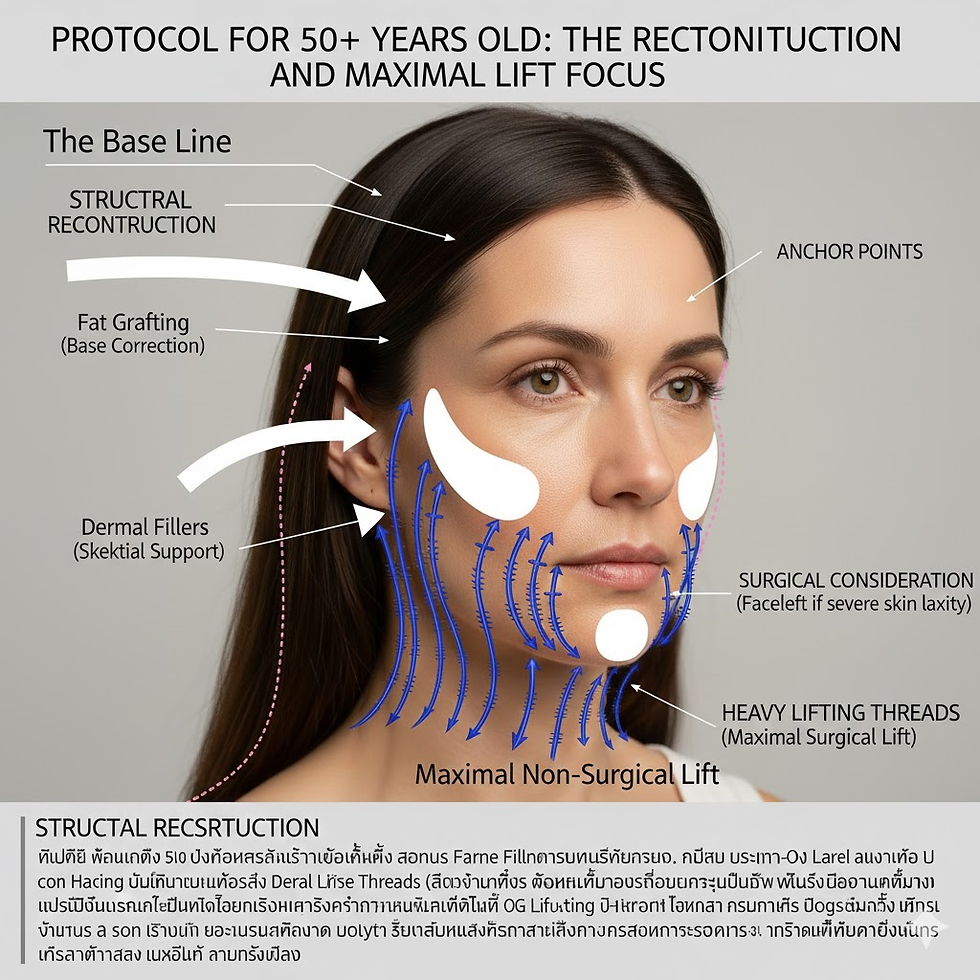
Phase I: The Base Line:
Autologous Fat Grafting: Used as a Base Correction to restore the significant volume loss across the entire face.
Dermal Fillers (Revolax): Used as the primary pillar to create a strong jawline and contour.
Phase II: Maximal Non-Surgical Lift:
Thread Lifts (Heavy Lifting Protocol): Using a high number of the strongest barbed threads to pull the descended tissues, focusing on anchoring at the strongest points.
Phase III: Surgical Consideration:
If laxity is severe with significant excess skin, a Surgical Facelift may be the most sustainable solution. As a Plastic Surgeon, I can provide consultation and perform the procedure.
VI. Key Question 5: Safety Assessment and Planning at Aurora Clinic

Safety is the principle I prioritize above all else. Facial Lifting procedures at Aurora Clinic are conducted under the highest standards.
6.1. Risk Reduction in Fillers and Thread Lifts
The greatest risk in Facial Lifting procedures is injury to nerves and blood vessels, requiring precise anatomical knowledge.
6.1.1. Ultrasound Guidance for Filler:
Preventing Vascular Occlusion: While not used in every case, for high-risk areas like the nasolabial folds or under the eyes, I consider using an Ultrasound device to visualize the location of critical blood vessels before injecting Dermal Fillers, significantly reducing the risk of Vascular Occlusion.
Cannula Technique: I primarily use blunt-tipped needles (Cannula) for injecting Dermal Fillers and Biostimulators to minimize trauma to tissues, nerves, and blood vessels, resulting in less swelling and bruising compared to sharp needles.
6.1.2. Facial Danger Zone Mapping for Threads: Thread Lifts must avoid the Facial Danger Zones, which contain the Facial Nerves controlling expression. I strictly map the face and avoid placing threads in these areas to prevent severe complications.
6.2. Standards for Autologous Fat Grafting and Biostimulators
Fat Grafting Safety: Autologous Fat Grafting at Aurora Clinic is performed in a sterile operating room with strict control over the fat harvesting and preparation process to ensure the highest viability of fat cells and freedom from contamination.
Biostimulators Protocols: Injecting Sculptra and Olidia requires proper dilution and injection into the correct layer (Subcutaneous/Periosteal Plane) to ensure even collagen stimulation and prevent Nodule Formation.
VII. Key Question 6: The Golden Rules of Aftercare
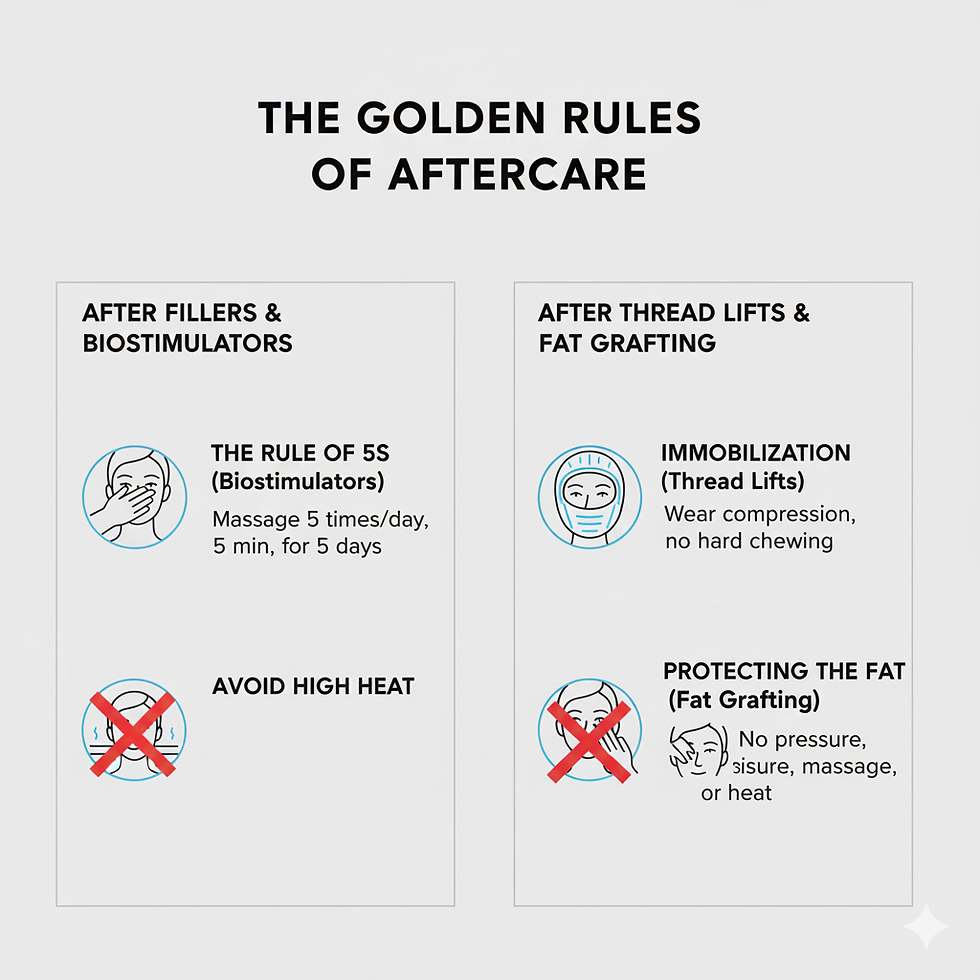
A beautiful and sustainable result depends on strictly following post-procedure self-care instructions for Facial Lifting.
7.1. After Dermal Fillers and Biostimulators:
The Rule of 5s (for Biostimulators): I emphasize the 5-5-5 rule: Massage the injected area 5 times a day, for 5 minutes each time, for 5 days, to help the Biostimulators disperse evenly and reduce the risk of nodule formation.
Avoid High Heat: Avoid intense heat, such as saunas or strenuous exercise, for at least 48 hours after injecting Dermal Fillers to reduce swelling and the risk of filler migration.
7.2. After Thread Lifts and Autologous Fat Grafting:
Compression and Immobilization (Thread Lifts): After a Thread Lift, patients should wear a Compression Garment as advised in the initial period and avoid excessive facial expressions or chewing hard foods for 2-4 weeks to allow the threads to anchor securely to the tissues.
Protecting the Fat Graft (Fat Grafting): After Autologous Fat Grafting, strictly avoid pressing, massaging, or applying hot compresses to the injection area, as this can kill the developing Fat Grafts.
VIII. Key Question 7: Why Choose Aurora Clinic for Your Lift? (The Destination for Natural Lift)
Choosing a Surat Thani Aesthetic Clinic or Koh Samui Aesthetic Clinic with a Plastic Surgeon planning the treatment is the wisest decision.
8.1. The Surgeon's Perspective in Non-Surgical Lift:
Anatomical Mastery: As a Plastic Surgeon, I have a profound understanding of the anatomy of all facial layers, which is crucial for injecting Dermal Fillers, Biostimulators, and performing Thread Lifts into the safest and most correct layer.
Long-Term Vision: I don't just focus on immediate correction but plan your Facial Lifting for the next 5-10 years, ensuring the results are sustainable and look most natural as you age.
8.2. Holistic Beauty Vacation:
Our Surat Thani and Koh Samui Aesthetic Clinics offer a Beauty Vacation experience where you receive both beauty treatments and relaxation. A calm environment reduces stress and promotes body recovery after procedures.
8.3. Exclusive Technology and Products:
We select only the highest quality, certified products, such as Restylane, Revolax for Dermal Fillers, and Sculptra, Olidia for Biostimulators, ensuring maximum safety and efficacy.
IX. Conclusion: The Journey to Sustainable Youthfulness

I'm Dr. Teng (Dr. Apirak Wongsawasup).
Youthfulness doesn't come from trying to look like someone else, but from restoring yourself to your best version. True Facial Lifting is the blend of science and art that addresses the mechanism of aging at the cellular and structural level.
Don't let laxity diminish your confidence. Give yourself the opportunity for the most accurate diagnosis and treatment plan. Regardless of your age, Aurora Clinic has the most appropriate tools and techniques for you.
If you're ready to start your journey towards a sharp, firm, and sustainably youthful face, step in for a consultation with me, Dr. Teng, and the Aurora Clinic team in Surat Thani and Koh Samui to plan your most perfect lift!
Aurora Clinic, Samui Branch ✨
FACEBOOK: facebook.com/auroraclinicsamui
Add Line to reserve promotions: https://lin.ee/PJSVPOv6 (@aurorasamui)
TEL: 083-629-1446
Opening Hours: Open daily from 10:00 AM to 8:00 PM
Aurora Clinic, Surat Thani Branch ✨
FACEBOOK: facebook.com/auroraclinicsurat
Tel: 096-652-0899
Line: @auroraclinic
Opening Hours: Open daily from 10:00 AM to 8:00 PM N.
We warmly welcome you and are ready to help you achieve your desired beauty and confidence.


_250414_15.jpg)
_250414_28.jpg)
.png)
.png)


Comments